But what really keeps me engaged
here is that they put their
money where their mouth is.
So it's not just saying that we wanna
reduce our environmental footprint,
is they actually take action and put
money towards the effort that's needed
to be a sustainable organization.
This is Facility Rockstars, the podcast
that celebrates the unsung heroes of
our daily lives, facility professionals.
I'm your host, Jay Culbert.
Join me as we honor these great
leaders, sharing stories, insights,
and expertise that empower us
all to learn and grow together.
Facility Rockstars is sponsored by
Kaloutas, operating the way you operate
in order to make your life easier.
Welcome back to Facility Rockstars.
I'm your host, Jake Culbert.
guest brings more than 30 years of
experience in facilities management,
environmental health and safety,
and operational leadership, with
a career dedicated to keeping
complex facilities running
efficiently, safely, and sustainably.
He's a certified facility manager
through IFMA, bringing both technical
knowledge and a commitment to
excellence in the facilities industry.
Before moving into the life sciences
sector, he spent more than 20
years as an environmental manager
at Altron Incorporated, building a
strong foundation in environmental
management and operational compliance.
He currently serves as the
senior director of facilities
at Cell Signaling Technology.
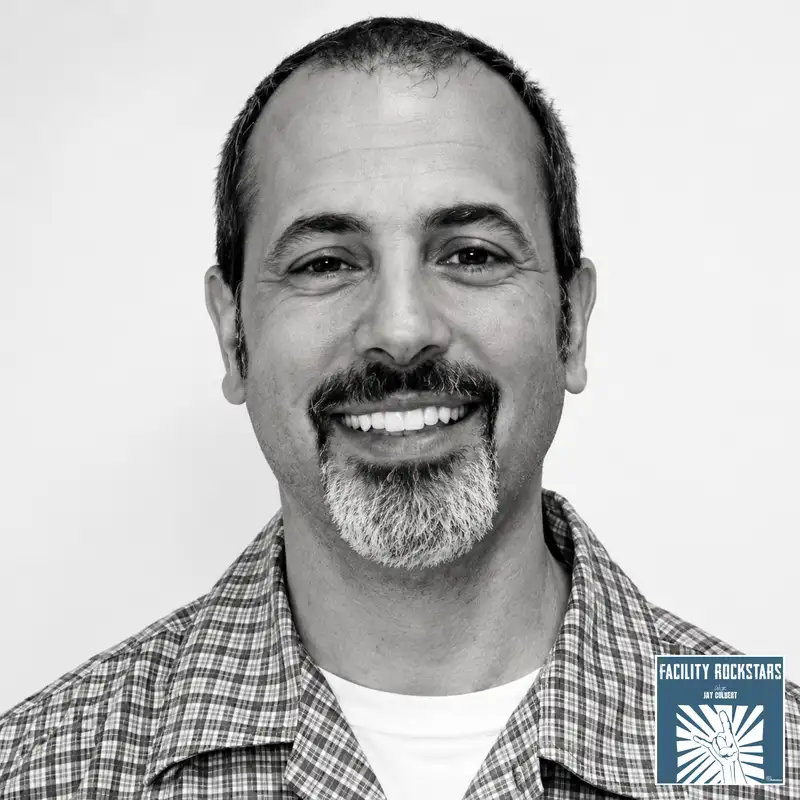
Peter Muto, welcome to the show
Jay, great to be here.
Thank you so much for having me.
I appreciate it
Thank you as well.
Really appreciate you investing
some time and sitting down with
me to have this chat, Peter.
M- my pleasure
Awesome.
Well, you've got quite
the accomplished career.
You've, you've done a lot.
I'm sure you've learned a lot.
You've probably, I'm
quite sure, taught a lot.
I'd ask, what's been your
biggest lesson learned?
Um, my biggest lesson learned would be
you're only as good as the people that you
work with, work for, and have around you.
Um, I, I, I would say that with all the
accomplishments that I've had in my life,
uh, in my career, um, a good portion of
it, if not the majority of it, has to
do with the people that I align with.
Um, you're only as good as the, the
people within your organization.
And, uh, that is a, that is a lesson
learned because anybody who's been in
a career long enough know that you can
work with people that, um, are active
and, and willing to participate in any
and all activities that, you know, any
job entails, and there's others that
may not have that same, uh, desire,
and that can end up being a very big
challenge for anybody who manages people
So I heard y- I love it.
I heard a couple of different things.
I d- I agree with you.
Um, your, your surrounding community and
your, and your, y- you well said, who you
work for, who you work with, who works for
you, et cetera, um, only as good as them.
You mentioned
Yep
um, maybe not a personality type, but
how does someone lean into their role?
Did I hear you correctly?
Yeah, certainly
Could you expand on that a little
bit and, and how that has an impact
and, and how you impact it as well?
Sure.
So i-in, in every organization,
uh, within a department, you have
a variety of different employees.
You got employees that come to work
every day and wanna do their job,
and that's it, and they're gonna
go home at the end of the day.
But yet they're excellent employees.
They're either technically knowledgeable.
They're, uh, a good worker.
They interface well.
They're, they're cross-functional
and do a lot of exceptional things.
But at the end of the day, that's it.
They don't wanna grow.
They just wanna retain
their current position.
But then there are others that are, I'll,
I'll use the term hungry, that are really
interested in career development, career
expansion, uh, moving into different
roles, different responsibilities than
when they were initially hired for.
And that can be a very exciting time
to bring someone along to help, uh,
develop them, provide them with the
tools and education necessary to enable
that enhancement in their career.
Um, and that's one of, to me personally,
a, uh, a highlight of my career when
I've ever had that opportunity to, uh,
develop somebody and help them along their
career path, um, ideally staying within
the same organization, but sometimes
that leads to them looking elsewhere to
be able to continue their career path.
Um, but that, that's an exciting
opportunity that, um, I really enjoy.
I, I agree.
It's, it's so thrilling
to see someone grow.
Can, can you tell us a
little bit more about that?
'Cause that's, face it, uh, you know,
you, you- people will move on and
hopefully they stay with your company,
but what's that experience been like?
Can you give us, us maybe some examples,
Peter, of how someone chose to grow
and what it did for them and the org?
Well, um, you know, I have a couple of
examples, but one that, that comes to
mind is that, um, within my organization
now, we have an employee that started
as a cleaner, came in from, um, uh, a
different business entirely, did not
know English as his first language,
and worked at our organization.
But even within that, he was a go-getter.
You could just see it.
Um, he learned English on his own
without having to go to, to school.
He just talked to anybody and everybody
would help him learn the English language.
And over time, what we found was that
this individual was interested in what
we did in the facilities world and always
asked to say, "Hey, if you guys are
doing anything, I'd love to help out.
Nights, weekends, you know, at times
that you may need an extra pair of
hands." And that developed over time,
and that individual transferred from our
cleaning company into our organization.
And then within our organization had
this strong desire to continue to learn.
And so now he is a key member of our team.
He has quite a bit of education under
his belt, both, um, in the trade schools
as well as in community colleges.
Um, so over a relatively short period of
time, I'd say a little bit over 10 years,
he's gone from somebody who, um, didn't
even know the English language to someone
who's a key member of our organization
What a great story.
What a great
Yep.
Yeah
heard his own ambition kind of
set him up for it, and then you
and your team and the organization
helped him flourish, 'cause he
Yes.
Right.
Yeah,
So it's that old adage, you know,
you can bring a horse to water, but
you can't make him drink, right?
The-- this individual had
the desire to wanna learn.
And so my role as a, as a leader
is to provide whatever educational
opportunities and give that breadth
of them to be able to do it, whether
it's during business hours, right?
Set some time aside in his daily
activities to be able to spend to learn,
take tests, be online if that's what
it requires, do lab work if that's
what's required within a trade school.
Um, maybe he has to leave early,
uh, a couple of days a week in
order to attend those classes.
Um, so it-- but the reward is significant
because now he is, uh, not only a, a very
educated, technically savvy individual,
but he really values our organization and
wants to retain and, and continue to grow
Good for him and good for the company.
Sounds an
Yeah.
culture where you are
Yep.
Yes, it is.
It's a tremendous culture.
One of the reasons I'm still
here, been here for so long.
usually the case, right?
I mean, people don't stick around
if it's a bad culture usually.
right.
Yep.
you?
Well, like I started, uh, in this
conversation is that, you know, you're
only as good as the people that you s-
that surround you and the organization
that you work for, and that's true for me
Right.
So I, I'd like to flip it, Peter,
'cause, like, on the show I like to get
very real, 'cause it's like, look, our,
our facilities isn't a straight line.
It's jagged.
Uh, things change all the ti-
And you mentioned a couple
of different things, right?
Someone who wants to grow versus someone
who's just good in their position, doesn't
wanna grow, wants to stay right there.
Is that a good or bad thing?
You know, is there a
different way to look at that?
How do you… I guess really my
question is, how do you handle people
don't wanna grow in a role that you're
like, "You know what? We need to get
you n- we, we need to get you to the
n- next level so we can level up the
department," or something like that
Mm-hmm.
Um, so to me, I value that individual
or individuals, depending on
how big your organization is.
Because the reality is, is that
there isn't gonna be always upward
mobility for everybody within your
department or your organization.
There is a need for those people
that want to, or those employees that
want to come to work every day and
do their job to the best of their
ability, do a good job, but go home
at the end of the day and that's it.
And I value those people, um, because they
provide a service, they do it very well.
It's not like these individuals
are just coming to work and just
going home at the end of the day.
They're actually providing
value to the organization.
So it's, it's-- I wanna be clear, it's
not about someone that is just existing.
This person or persons do a very
good job, and we value that.
But the reality is, is that if-- in
our organization, it's relatively
small, and there's not always that
opportunity for upward mobility.
So you need that balance of people
who wanna come to work every day and
do their job and go home, but you
also would love to have those other
individuals that are thirsty, want
career development, want to learn more,
and eventually get into some sort of
leadership role, whether it's supervisory,
managerial, senior level, et cetera.
Um, so you want that balance.
I think that's a great way to
run a department if you can,
if you can make that happen.
Excellent.
Do you mind if I stick on
this topic for another minute?
Not at all.
Sure.
Ask away
what you're saying because I, I also
believe that, that it takes both types
of personalities and, and mindsets,
uh, for different roles, right?
But what about someone who you have in
a role that does require growth, and how
have you ha- 'cause I'm, I'm guessing
you've come across that d- over the years.
How do you help someone like that
develop, or what do you do that it
doesn't necessarily have the ambition
of the person you described earlier?
Yeah.
So, um, I think you'd have to have a
candid conversation with that individual
to say that there is a skill or skills
that you currently don't have that would
be not only valuable to you, but to the
organization, and we need you to embrace
the opportunity to, to learn this skill
or skills that you currently don't have.
We will provide the resources and the
education to enable you to achieve this.
But at the end of the day, we wanna
know whether you have that appetite
to include these additional skills
within, um, your current position.
Now, that can lead to
two different decisions.
One is, "Yes, sure, I'd love to
do that," or second, "No, I'm
really happy with where I am."
Now, that can lead obviously to some
decisions that may be tough decisions
to make, whether you need to find a
new role for that person potentially
within the organization, or you may
have to move on from that individual.
Um, ideally, that's
not what we would want.
We would want to at least find
another role within the organization
if, if that was, uh, the situation.
But more times than not in my career,
I found that people were excited
about the opportunity to learn
new skills that they didn't have.
Some of them didn't even realize that
they needed it, and that could fall on
me, it could fall on the organization
for not communicating that well.
But, uh, there has been a couple,
but it's been few where, uh, we've
had individuals that we've had
to relocate to different roles
Appreciate that very much.
Sure.
that's,
Yeah
just good leadership too.
Um,
Yep.
Yep
Peter, I'd like to… W- I know we
chatted briefly about this, but,
um, could you kind of just walk,
uh, our, our audience and myself,
of course, through your career path?
what journey have you taken here to get
you to the point you're at right now?
Uh, kinda like you said in the
beginning, it's, uh, it's kind of a
zigzag path to get to where I am today,
um, which I'm sure other people who
listen to this can, can appreciate.
Um, so I graduated from
Springfield College with a dual
major of biology and chemistry.
And when I graduated, um, I ended up,
my first career, which ended up being a
career I was in for quite a while, was
in printed circuit board fabrication.
So I started as a process engineer,
ended up being a chemical process
engineer to a, uh, principal
process engineer in that field.
And I was there for quite a long time
at the company you mentioned at, in the
beginning called Altron Incorporated,
a private company in Wilmington, Mass.
Um, and I loved it.
It was a great industry.
It was very exciting.
And again, the people in the
organization were terrific.
Loved working there.
Um, a lot of challenges i- in
that, in that industry, but we
were a very unique organization.
Um, and we really grew dramatically
during the '90s in the tech boom.
Well, as everybody knows, it crashed in
early 2000s, the late '99, early 2000s.
And so they ended up
closing that business.
Um, and also I forgot to mention,
while I was there, I was also, um, in
environmental compliance where I ran
the wastewater treatment facility.
Um, you know, handled, uh,
hazardous waste and disposal of
material and coordinating all that.
Um, but once the business, uh, it didn't
close, but it consolidated, um, I ended
up moving on to another career, um, in
the military, if you will, with Goodrich.
Um, not the tire company, but related.
Um, they were originally in, in
Chelmsford, Mass, um, and now
they're actually, I believe,
Collins Aerospace at this point.
I was there for a number of months and
then, uh, a short period of time as EHS,
um, director, uh, and facilities director.
Um, but then I was able to,
um, get a career here at
Cell Signaling Technologies.
Um, and I've been here ever since.
And so my role here is, you know, I
was facilities manager, and now I'm
senior director of facilities over
the course of the time I've been here
I appreciate you walking us
through that because, like,
look at your, your dual major.
Was it chemistry and biology you said?
Correct.
Yes
you may not think that's
an FM launchpad, right?
Yep
then the, what… Yeah, everything
you just walked us through, and then,
then you, you went to the, uh, en-
en- environmental health and safety
sector or area first, and then FM.
Was there a reasoning for that?
Just an open
Yeah.
or choice or-
Well, that, that was-- that's
an interesting transition.
So, um, while the company was, um, doing
terrific, uh, there was an executive
vice president that worked there
that saw the work that I was doing in
the, um, call it the printed circuit
side of the business, if you will.
And, um, he recruited me.
He internally recruited me from
the, uh, engineering side of the
business to the environmental
compliance side of the business.
So that's how it happened.
Um, you know, he pulled me into his
office one day and he said, "You know,
I really think you're doing a great
job, but there's this opportunity that
I'm interested in, in creating this
position for, and I think you would fit
terrific in it if you're interested."
So, uh, I can still remember I took the
weekend to think about it and came back to
him on Monday and said, "Sure." And, uh, I
think it was a, a really great transition
for me because it opened up a whole bunch
of new doors, uh, in my career, uh, that
I probably wouldn't have had exposure to
if I had stayed in the engineering side.
Um, so very happy I did that.
But that's how that happened.
Yeah, no, I love the, I
love the way it happened.
I mean, you were,
Yeah.
you were recruited.
What better way, right?
yeah.
have
Internally recruited.
Yeah.
The choice is mine.
Yeah, it was great
it's cool what you said too, like, like
it opened up so many doors and, like,
when we look back, right, like think
about the things that may not have
happened because of that one little
choice we might have made, right?
So that's
good for
Yeah.
Yeah
so, like, follow-up question, right?
Do you li- … So was there
one that you liked the most?
Like, do you like FM more than
EH&S, or could you… Is that
a relevant question for you?
Yeah.
I mean, I, I would say I probably
like FM more than I did, um,
any other work that I did.
But I wanna be clear, there was a
lot of fun and a lot of enjoyment
when I was in the printed circuit
engineering side of the business.
There was a, there was a lot of things
that happened there that I really
valued and miss, quite honestly.
Um, but overall, I think facilities
management really fits well with
my personality, what I'm interested
in doing on a day-to-day basis.
The impact that facilities management
has on an organization, um,
that's-- it's, it's palpable, right?
I mean, you can see, feel, and hear
it from your customer base on whether
you're doing a good job or whether
you're not doing a good job, right?
All the way up, and I'm in another
private company, so it's not unusual
for me to hear directly from our CEO
on things that are not going well.
So, um, you, you get sometimes
immediate feedback on your performance
Yeah,
Oh, I do like that.
I'll say
Yeah, it is.
I- it's
It most certainly is
usually it's when something isn't
right, when there's immediate
attention it's addressed, and
yep
maybe it should be.
so let's, let's stick with that
when things don't go right.
Um, let's stay right there,
and this could be in a previous
role, current role, either way.
Can you pick a situation or a
scenario, Peter, where things were
just, they were going sideways?
This was a really challenging
situation for you and your team
uh, you know, share that with us
Um, so I'm gonna pick an example that
I'm not sure this would be the greatest
example, but I'll use it anyway.
Um, so back in the printed circuit board
days, um, we created this division that
we called the quick turnaround division.
Um, and the objective there was at the
time there was long lead times to get
product to your customers, you know,
16 weeks or longer in some cases.
So we spun off this division that
I was a member of that we tried to
do things within a week, sometimes
a little bit longer, right?
But it was, it was smaller volume
product, but we could for test
environments or, uh, other purposes,
we would turn product around quickly.
Well, I was running a section of the
division that dealt with, um, etching and
vats of, of chemistry, et cetera, that had
catwalks and platforms on that you would
be dipping printed circuit boards in.
Well, I come into the room one day
and there's these two guys on the
catwalk, and they're in fisticuffs.
They're like, like they are going at it.
And so I, uh, I separated
them, pulled them aside.
I fired them both on the spot, and I
went to HR, and I got my wrist slapped.
Like,
'Cause you did it right away
without their permission?
you like, "You can't do that." I go, I try
to explain the situation to them as calmly
as I could, and they're like, "Yeah,
that's fine, but you still can't do that."
And so, um, that was a challenging
situation that I still remember to this
day on that, you know, you really, in
certain circumstances, you really need
to take a step back, look at it from a
different perspective before you start
making rash decisions on something.
And I know that example was about
personal issue, if you will, between two
people, but you can carry that into your
business and look at business-related
issues that you may not necessarily
agree with, um, or you may even agree
with strongly, and you take quick action
to, um, either embrace something or
push something away without maybe taking
a, a 30,000-foot view of something.
Um, so that was a lesson for me that
was, was learned along the way that I,
Mm-hmm
I take in a lot of decisions as I,
as I move forward from that point.
I appreciate you sharing that, Peter.
A lot of humility in you sharing that too.
That's, that's a…
Yeah
can only imagine.
Did you say it was a,
was it a plating line?
Yep, it was a plating line.
That's for sure.
And they were over…
fighting.
No.
Yeah, one wrong step, someone
could have been seriously injured
Yeah.
Yeah,
Oh.
lesson learned though.
Um, we, we chatted briefly
about sustainability.
Can you talk about, just about
sustainability as, as a topic as a
whole, and then how does it impact your
org and maybe your role and your team?
Um, well, I'll say this organization
really fits well with my own personal
principles around sustainability.
Um, you know, our company has been
founded by scientists that one
of their driving missions is to
reduce the environmental footprint.
And that's a great tagline and something
that I think everybody who would listen
to this would say, "Oh, that's wonderful."
But what really keeps me engaged
here is that they put their
money where their mouth is.
So it's not just saying that we wanna
reduce our environmental footprint,
is they actually take action and put
money towards the effort that's needed
to be a sustainable organization.
And if you just go to our website
and take a look around at what
we've done, it is prolific.
And I can say that any show that or
conference that you go to that you talk
about opportunities for sustainability
initiatives, we've pretty much done
them all, and they're implemented,
and they're active currently.
Do we have a lot more to do?
Absolutely.
Um, we are clearly not done.
But things that are expensive but show
a ROI that is worth the investment,
it's like, "Okay, let's do it," right?
This makes sense.
Um, so that opportunity to really
engage with not only my organization,
but we actually have a sustainability
department, our employees, um, and
our customers and our vendors that we
buy product from, um, we all jointly
try and work together to reduce the
impact that we have on our environment.
And I can list lots of examples
if that's important, but, um,
uh, we've done quite a bit.
And so that really keeps me engaged.
And honestly, it's one of the
foundational reasons why I'm still here
That's a big statement to make.
That's… And again, actually
you align with the culture.
You're aligning with the culture
of sustainability with the company
and your own beliefs, right?
And what's
Yeah.
That's,
Yep
Now, you, you mentioned, um,
examples of it's important.
I think a couple, only
because, like, let's frame
Sure
If someone's listening, Peter, and
like, "Yeah, you know, I wish my
organization did more," or they wanna
do more, but they're not sure how to
start or what to do, what would you say?
Um, so for us, when we f- when I
first got here, which was 21 years
ago, we started this grassroots, you
know, organization for sustainability.
We called it the Green Committee, and it
was, um, cross-functional group of people
from the scientific side to the support
side to the administrative side You formed
this organization, you had a two-year
stint on the commu- on the, um, uh, on
the committee to develop ideas on how we
can reduce our environmental footprint.
So ideas that we have done.
So on our in-house caf, everything in our
cafeteria that you use, with the exception
of utensils, is 100% compostable.
Right?
Um, our product back in the day
when I first started, uh, we would
ship stuff in styrofoam boxes.
Within five years or so when I started,
so this is like mid-2000s, 2006
maybe, 2007, we converted all of our--
eliminated all our styrofoam and, and
designed and made our own, uh, cardboard
containers to ship our product in, right?
With our, our, our labeling
and everything else.
Um, what else have we done?
So we are a strong participant
in, uh, plastic recycling.
So we use a variety of customer-- I mean,
a variety of organizations that we recycle
our plastic, our lab plastic with, as well
as any other plastic that gets generated.
We recycle styrofoam that comes in
from, um, outside organizations that
ship their products still in styrofoam.
Um, we recycle gloves.
So anybody who's recycled gloves can find,
you know, what that challenge is when
you're trying to recycle nitrile gloves.
Um, we're 1% for the Planet, um, which
if you're familiar with that, 1% for
the Planet is you're donating 1% of your
top-line revenue to 1% for the Planet
as part of our sustainability efforts.
Um, we have, uh, fostered with
organizations in Costa Rica to
grow trees on behalf of, uh,
reforestation in, uh, Costa Rica.
Um, we have significant number
of, uh, energy conservations
measures that we've installed.
One, one recent one that we did that's
been very successful is installation
of Aircuity for, uh, air management or
airflow management in our facility in
Beverly, um, that has, uh, dramatically
reduced our energy conservation-- I mean,
our energy consumption at that facility.
So that's a short list of some
of the things that we've done.
We've done a lot more than that, but, um,
you know, it's one of the nice features
of working here is that, uh, we're able
to get approved to do a lot of projects.
You may call it a short list, but, um, I
think probably a lot of people would think
that's a pretty robust list actually.
Yeah.
Um, yeah, it's impressive, Peter.
Thank you for sharing that.
I wanna jump
Sure
you said the green committee.
It all started
Yep.
the green committee.
So
Yep
leadership and ownership, if I'm
hearing you correctly, is, is a
dri- is a driving force behind this.
The green committee really got it going.
How do you keep it going?
Is it just simply those two things?
Um, so, you know, the Green Committee
was extremely valuable because you got
to hear from the scientists on the floor
on what issues that they're dealing with
on a day-to-day basis, and things that,
from my role, that I wouldn't be privy to.
I wouldn't have that knowledge
base to understand what they're
dealing with on a day-to-day basis.
So when you have that cross-functional
group of people in a room bantering
about ideas on things that we can
do to, to save, uh, reduce our, our
environmental footprint, how to recycle
items, how to reuse them more than once
maybe before you actually toss them,
um, a lot of that would not even come
to fruition without that interaction.
But how do you keep it going?
The, the second part of your question
is you really need to have a group of
people who are excited and have the
desire to want to continue the effort
of not resting on your laurels and
say, "Oh yeah, we already did this,"
and, "Okay, we're good for now." No,
it's like you want, you wanna be able
to have a group of people that said,
"Yeah, this is great, but I want more.
We have this opportunity in front of us.
We have this opportunity in front of us.
We have this opportunity." And then
make a strong justification on why it's
valuable to put resources, financial
resources towards this activity or this
project, and hopefully you can get that
justified and approved to move forward on.
It's impressive, very impressive.
Thanks for walking us through.
I'm sure people appreciated
Sure
get going with their
sustainability program too.
And a lot of times, Peter, you'll see
people reach out after the show, of
course, uh, so you- I'm, I'm guessing
you're gonna get some contact on this
Yeah.
Well, I, I will say if I could just say
one other thing about the green committee.
So for people who aren't doing
this currently, um, it's a very
cost-effective way to get people engaged.
It-- The-- What's really the, the most
impactful thing is creating the time
out of people's day to be able to sit
in a conference room or some space
where you can banter about ideas, right?
So if you're willing to do that, um, I can
pretty much assure you that you're gonna
come away from that meeting with ideas and
maybe even a long list of ideas on things
that you can start taking action on.
So one step at a time is
what-- I mean, we didn't get to
where we are today overnight.
It took quite a long
period of time to get here.
Um, but that's how it started
That's really good advice.
So that, you know, you, you have to be
willing to invest the time, bottom line,
correct.
Yep.
on it.
Yep
Um, look at the news, look at our,
our lives, look at everything.
When we wake up in the morning,
everything is AI all the time, right?
So you can't, you can't go through a day
without hearing about what AI is doing
in business, personal life, et cetera.
So that being said, you and I
chatted briefly, like, what's the
impact of, uh, you know, AI on
your role and on your organization?
How are you using it?
What's the impact, et cetera?
So w- we're a life science company,
and anybody in listening to this,
a life science company, what I'm
gonna say isn't gonna surprise
you, but it is foundationally
changing our business, right, on
how we work on a day-to-day basis.
Um, we've recently gone through
some organizational changes here
based on the how we plan to leverage
AI, um, within our organization
and within our business model.
Um, because it's here, like
it or not, it is here to stay.
It is gonna be, uh, a tool that you can
use to help, um, in a variety of different
ways in our business, but also within
FM. Um, it is also gonna be beneficial
and impactful to the way that we operate.
So, um, when I think about how it's gonna
impact FM, I really doubt in the very near
future it's gonna replace people, right?
Um, however, what I think it can do
is it'll provide opportunities for
us to look at ways that we can be
more, uh, predictive versus reactive.
So I know there's all kinds of tools
out there already that they're calling
predictive AI that can layer on top of
your BMS or BAS, whatever you wanna call
it, um, that can help look at the data,
uh, within your, your BAS system to look
at ways that you can predict upcoming
failures or, um, end of life of devices
or meantime to failure for devices that
you can predict when those items need to
be either addressed, replaced, repaired
in advance of a partial or full failure.
So that's out there already, and there are
a number of companies that are promoting
it, and I think, uh, from what I have
heard and seen, it's pretty successful.
Um, but it also is for us in our
organization, how we're using it now,
if, if we need to find something as
simple as an owner's manual or specific
information about a piece of equipment,
uh, I mean, it's at your fingertips.
There's no more need
for paper documentation.
You don't need to have these realms
of books and, and documents to be
able to have at your fingertips.
Now, you may like that, but you
also have it available digitally.
And, um, the queries that you can
make, um, through AI are, are just,
uh, they can be profound and helpful
to you in a, in a lot of ways.
From visuali- visualizing your
data in a variety of different ways
you may be currently not doing.
Um, those are the ways that I
see AI really being beneficial
to, um, our workflow.
How have you found adoption
from your company, the team?
You mentioned, if I, if I recall
correctly, that there's already been
some org changes due to this, or
structural, uh, changes due to AI.
How's the adoption been?
What are the challenges?
So the company as a whole, I think
the adoption rate has been very high.
Um, I, I can't put a percentage on
it, but I know that m- myself and
my staff uses AI on a daily basis.
Um, however, the, the
adoption of AI is one part.
It's just how well and how
deep you are using AI, right?
The simple example is, you know, you
type an email, you can use AI to clean
up your, your, your, your email, right?
That's, that's one simple way to use it.
Um, but the prompts that you can use in
AI now, um, can be extremely complex to
get extremely detailed responses from.
And there are so many different platforms
out there which can be really overwhelming
on, on, uh, AI and the, you know, the
feedback you get depending on the platform
that you use is also, uh, impactful.
Um, but, you know, the adoption rate here
has been, been high as an organization.
I, I would say that there are people
within my department who are more
old school and, um, you know, they
use it, but they're not taking full
advantage of it, which is, uh, you
know, a learning opportunity and
a teaching opportunity on my part.
Um, so we do have lots of training
and, um, both online and in-person
training that we are promoting within
our organization to help people take
full advantage of really leveraging
AI to get the full benefit out of it.
So we're still in the, uh, infancy
stages of, of rolling it out and using
it within our department and some
of the other support departments.
But make no mistake, it's
here and it's gonna stay here.
That's, that's good to hear.
It's good to hear.
So I, I like how you, you, you,
you answered my adoption question,
but then you said really it's about
how deep are you willing to go,
how much are you willing to invest,
how, in, in the time, and how much,
how, how well do you use this thing?
Yeah, you
Yeah.
it.
Are you just correcting
your emails with it?
What more
Yeah.
Yeah.
Yeah, right.
Um, and so the-- it, it
is a very powerful tool.
Um, and so it, it can provide a
lot of benefits if used properly.
Agreed
will say this, what I have learned,
and a lot of people have learned
as well, is that AI is not perfect.
So you cannot take AI, um, even with a
deep dive, with a, um, you know, verbatim.
You need to read and understand
the information that is provided
to you and do a check and balance.
Um,
Mm-hmm.
so
100%. Yep.
very well said.
Um, on your career path and
what you've learned, what you've
accomplished, I mean, you've been in
this business for a while, and, and
actually a few different businesses.
What advice would you give…
Let me position it two
different ways for you, Peter.
What advice would you give someone
entering their career aspiring to be where
you are today doing what you do today?
Um, so I- I'm gonna use a sports analogy.
Love
and that, that is, you know, my sport of
choice was soccer, and I love that sport.
And as a young player, I wanted
to get better, and I practiced and
practiced and practiced and practiced.
But nothing replaces playing with
someone who's better than you.
Hmm.
So finding someone or people
that you admire, that have a
good foundation for what they're
currently doing, and learn from them.
Um, to me, that would probably
be the single biggest lesson
that I could suggest to someone.
And I'm, I'm making the
assumption that the career, an
FM career is where you wanna be.
Um, assuming that's the path that
you wanna go on is to find somebody
that has been there and done that,
so to speak, and learn from them.
Um, and try and pick their brain,
understand what some of the questions
like what you're asking me today,
they would ask that person or persons,
um, that they look up to, to try and
understand some of the challenges
along the way and how they can, uh,
maybe avoid some of those challenges,
so not repeat what was already done.
And, uh, find maybe somewhere in there
they'll find a nugget that they're
really interested in and lead them
down the path of, um, whatever aspect
of FM that interests them the most.
So outstanding advice.
I wrote down play with someone or learn
from someone who is better than you.
That's
Yeah
Like, like just if you want to level
up, get, go, go get someone who's
better than you and learn from them.
That's right
Yeah.
Now would you, so would you take that, so
take that advice question and now let's
position it to, uh, a peer, someone who
does something similar to what you do.
Would you give the same similar advice or
would you, would you change that advice?
With a peer, um, no, probably the
advice would be a little bit different.
Um, trying to think of
how I would frame that.
But, um, when I think about a
peer, it would be something that
we would learn from each other.
So I would say that if they're, uh,
you know, a peer in you-- whatever
field that you're in, there's gotta
be similarities of how you got to
where you are in some respects.
Maybe the path wasn't the
same, but now you're there.
Um, some of the criteria and information
that you learned in that role, you
could probably share stories with
each other that could be helpful to
each other, um, to-- things to avoid,
things to s- pay more attention to,
things that maybe you found to be
successful that the other person would
go, "Oh, huh, that's a great idea.
I didn't think of it that
way," and vice versa, right?
So learning from each other from
a peer group perspective, um, I
think is a great way, uh, to do that
I love that.
One of the, uh, one of the gentlemen who
was on the show, uh, last year, he's like
the global VP of facilities for a company,
and he gets with another of his peers
just, and once a month, they just banter.
They just, you know, learn from
each other like you're suggesting.
So very good advice.
Yeah
Right.
I, I do, I do that as well, which is how
I thought of that, is that I'm, I'm in
a, a monthly get-together with, uh, a
peer of mine, uh, where we banter about
ideas and, and learn from each other,
things that we have done that have been
successful, things that we've done that
weren't so successful, and vice versa.
So we, we, we tend to,
uh, learn from each other.
Awesome.
Awesome.
Yeah.
Well, Peter, before we wrap, I want to
flip it here, uh, just, just a little bit.
And, um, you know, this is a
tremendous amount of information.
You know, we've taken your career,
and you've given us nuggets of wisdom
here, and appreciate that very much.
Um, what does Peter enjoy when he's
not doing all of the sustainability,
AI adoption, implementation, and
everything else we've discussed?
What ke- what, what, what
do, what do you enjoy?
Oh, goodness.
Um, I like to travel.
Um, so my wife and I do, uh, a different
travel location every year pretty much.
Not all the time.
We have some repeat offenders,
so to speak, or places we
like that we go back to.
Um, but we, we travel.
Um, I enjoy cars, so the opposite
of my sustainability, um, realm.
I like gas-powered vehicles.
Sorry for those on, on the call
that like electric vehicles.
So I have, I have a couple of, uh, um,
sport cars that I, that I like that
I take to shows every once in a while
and don't really drive that much,
Yeah.
honestly.
They just sit in my garage.
Are we talking vintage,
vintage stock here?
What are, what kinda, what do you like?
one of them's a 2008.
They're both, uh, Audi, uh, cars.
Uh, one of them's, uh, an RS4
2008 vintage with very low miles.
And then another one, uh, a '23 RS6,
which is a, this, the wagon that
I just enjoy driving sports cars.
Um, I also have a motorcycle.
I love motorcycle riding.
I have a Harley Davidson.
Um, so I love, my wife and I love going
out on motorcycle rides this time of
year and in the spring are our favorite
times because you're not, you're not
sweating as you're riding around.
So, uh, we, we enjoy that very much.
So that's kinda what I
like to do outside of work.
Love that.
And we're in a great part
of the country for it.
Do you ever take, uh, Route 1
up, you know, the Maine coast
Oh, absolutely.
Yeah.
Yeah.
And I, um, I live on the North Shore,
so I do a lot of 133, 127 routes, Route
1A, um, up to New Hampshire and stuff.
It's, it's great.
Very nice.
Very nice.
so Peter, if people wanted to reach out,
uh, and I'm quite sure they will with
Yeah
we just talked about, what's the best
way for them to get in touch with you?
Um, well, there's a couple different ways.
One is my email, um, which I can tell you,
but, uh, you're welcome to share my email.
Um, they can also, uh, chat me
if they wanna do it that way.
Um, um, or at the very
least they can call me.
Okay.
any of those methods.
I'm, I'm-
it- Sorry, we'll put it in the show
notes, but if you want to say your
number and email, go right ahead
All right.
So my, my email is pmuto@cellsignal.com.
That's P-M-U-T-O @cellsignal.com, and
my telephone is nine seven eight-five
seven eight-six seven three six.
Perfect.
Perfect.
Okay?
Yeah
thank you so much for taking your time.
You invested a nice amount
of time here and sat down and
taught us all a bit today.
I really appreciate that
Yeah, no problem.
My pleasure
All right.
And everyone listening, thanks for
tuning in again to Facility Rockstars.
It's been another amazing show,
and you can catch us every Thursday
wherever you get your podcasts.
We'll catch you next time.
It's a wrap.
Another episode of Facility
Rockstars is in the books.
Facility Rockstars is sponsored by
Kaloutas, operating the way you operate
in order to make your life easier.
Until next time, facilitate and rock on